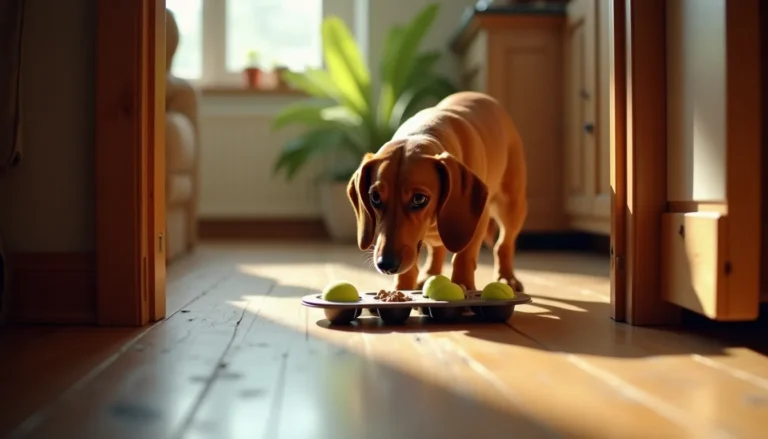
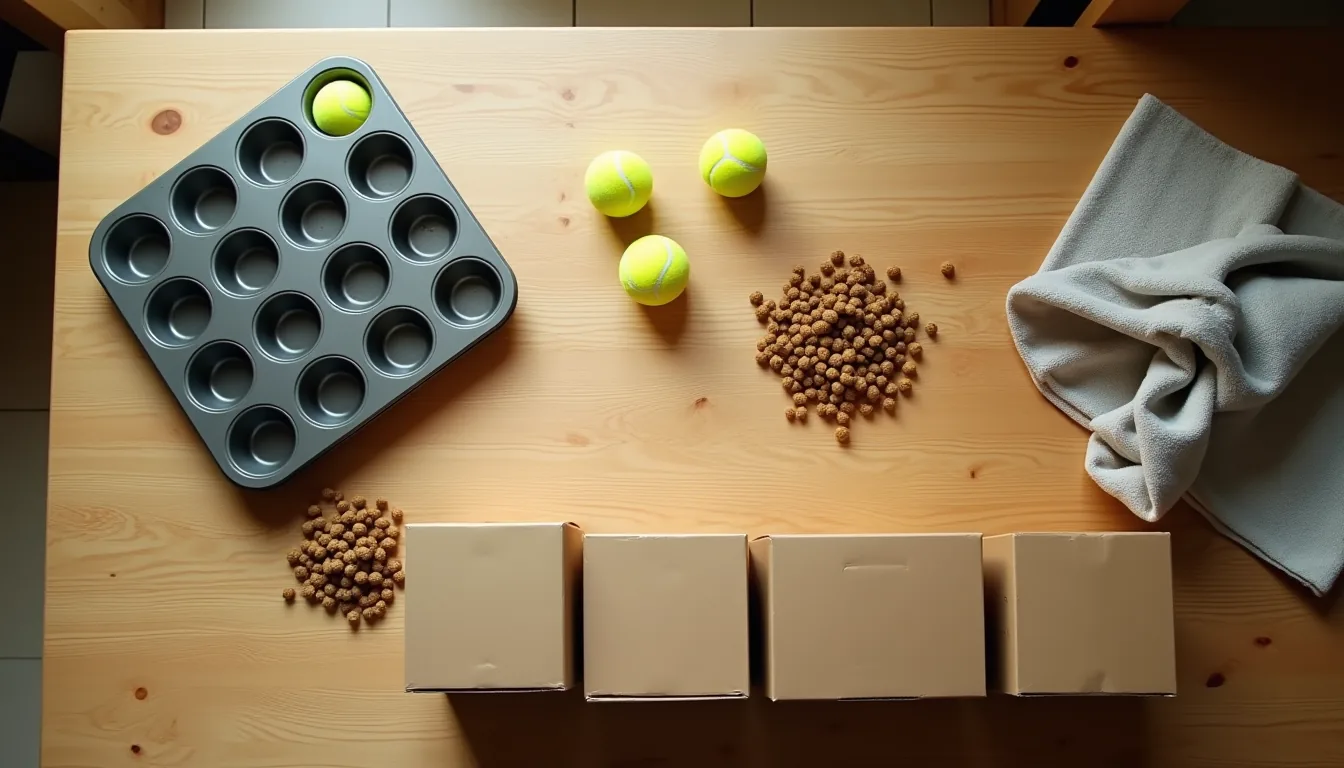
The best stimulating games for dogs don’t require a trip to the pet store — a muffin tin, three tennis balls, and a handful of kibble can keep a bored Lab busy for twenty minutes straight. If your dog has been pacing, whining, or destroying things by 10 a.m., the problem usually isn’t energy — it’s that their brain hasn’t been asked to do anything. Mental work tires dogs out faster than a walk around the block, and most of it costs nothing.
Why Stimulating Games for Dogs Work Better Than Extra Walks
A 20-minute nose work session can leave a high-drive dog more settled than an hour-long run. That’s not an exaggeration — it’s something most owners notice the first time they try it. The reason comes down to how dogs process effort. Physical exercise burns calories. Mental effort burns cognitive resources, and the recovery from that kind of work looks a lot like genuine rest.
According to the AKC, mental stimulation helps reduce problem behaviors like excessive barking, destructive chewing, and anxiety-driven pacing — behaviors that often get misread as a dog needing more exercise when they actually need more engagement.
The practical takeaway: if your dog is still restless after a long walk, add a 10-minute brain game before you give up and add another mile. You’ll likely find the restlessness disappears.
This is especially true for working breeds — herding dogs, terriers, retrievers — whose ancestors spent all day solving problems. A 45-minute fetch session gives them physical output but zero problem-solving. Mix in a sniff game or a puzzle feeder and you’re addressing both needs at once. For more ideas tailored to high-drive breeds, our guide on enrichment for high-energy dogs covers the specific formats that work best for dogs that are hard to tire out.
5 Easy Stimulating Games Using Only Household Items
Before you buy anything, raid your kitchen and recycling bin. These five games require zero special equipment and work for dogs at any skill level.
The Muffin Tin Game
Place kibble or small treats in a few cups of a standard muffin tin, then cover all the cups with tennis balls. Your dog has to nose or paw each ball off to find where the food is hidden. Start with only two or three cups covered so they learn the concept, then work up to all twelve. Once your dog masters this, start hiding treats under only one ball and leaving the rest empty — the increased uncertainty makes them work harder.
The Box Shuffle
Set three identical boxes upside down on the floor. Hide a treat under one while your dog watches, then shuffle them slowly. Ask your dog to find it. This tests short-term memory and focus. Most dogs figure it out within three tries and then demand you keep going.
The Towel Roll
Lay a bath towel flat, scatter kibble across it, then roll it up loosely. Your dog has to unroll the towel with their nose and paws to reach the food. It’s messier than a puzzle feeder and dogs seem to love it more because of that.
Scatter Feeding in Grass
Skip the bowl entirely. Toss your dog’s entire meal portion into a patch of grass and let them sniff it out piece by piece. A meal that takes 45 seconds from a bowl takes 10 minutes this way — and the sniffing itself is calming. This is one of the simplest free brain games for dogs at home that still delivers real results.
The Which Hand Game
Close a treat in one fist, present both fists to your dog, and wait. When they nose or paw the correct hand, open it and reward. Simple, but it builds impulse control alongside the problem-solving, which is a combination worth practicing daily.
Nose Work and Scent Games: The Most Underused Category
A dog’s nose contains roughly 300 million olfactory receptors — compared to about 6 million in humans. Scent work doesn’t just entertain dogs; it engages the part of their brain that’s most developed and most underused in the average pet’s daily life.
You don’t need a formal nose work class to start. Hide a smelly treat (something with strong odor — cheese, hot dog, freeze-dried liver) inside a cardboard box placed among several empty boxes. Ask your dog to “find it.” When they alert on the correct box, reward immediately and enthusiastically. Over several sessions, add more boxes, then move to hiding the item in a room rather than a box.
The key rule: let your dog work independently. Hovering over them or pointing at the right box teaches them to watch you, not use their nose. Step back, stay quiet, and give them the space to actually solve the problem.
Scent games transfer well to rainy days when outdoor time is limited. Our roundup of rainy day enrichment ideas includes a few scent game variations that work well in small apartments.
Training-Based Games That Double as Mental Stimulation
Ten minutes of focused training is one of the most effective dog mental stimulation activities available — and most people already have the tools for it. The trick is treating it like a game rather than a chore.
Rapid-Fire Cue Rotation
Ask for five known cues back to back — sit, down, spin, touch, stay — with a treat reward after each. Keep the pace brisk. The mental effort of switching between behaviors quickly is surprisingly tiring. Three rounds of this, and most dogs are ready to settle.
Shaping New Behaviors
Pick an object — a cardboard box, a plastic lid — and reward your dog for any interaction with it. First nose touch, then paw touch, then stepping inside. You’re not luring; you’re waiting and rewarding. Shaping teaches dogs to think creatively and try new things, which builds confidence alongside the mental workout. According to the ASPCA, reward-based training strengthens the bond between dog and owner while reducing anxiety-related behaviors.
Name That Toy
Teach your dog the names of their toys one at a time. Start with one toy — say “get your ball” every time you hand it to them. After a week, place it among two other objects and ask them to fetch specifically that toy. Dogs who learn 5+ toy names show noticeably better focus during other training sessions — the vocabulary work seems to build general learning ability.
Puzzle Feeders and Interactive Toys: Choosing the Right Difficulty
A Level 1 puzzle feeder — the kind where your dog just nudges a cover off a cup — will bore a smart dog in under a week. A Level 3 puzzle introduced too early will frustrate a beginner dog and put them off puzzles entirely. Matching difficulty to current skill is the most important variable when choosing interactive feeders.
Start one level below what you think your dog can handle. Let them succeed easily for the first few sessions. Then introduce the next level. If they give up after 90 seconds and walk away, the puzzle is too hard — drop back down. If they solve it in under 30 seconds without really trying, go up a level.
Rotate puzzles every two to three weeks even if your dog still enjoys the current one. Novelty is part of what makes puzzle work mentally demanding — a familiar puzzle becomes a motor habit, not a thinking task. Our full list of puzzle ideas you can set up at home includes both bought and DIY options at every difficulty level.
For dogs who have never used a puzzle feeder before, start with scatter feeding or the muffin tin game (described above) to build the concept that food requires effort before introducing a commercial puzzle.
Our Picks
These three product categories consistently outperform generic toys for sustained mental engagement:
- Adjustable-difficulty sliding puzzle feeder — the kind where you can reconfigure the number of hidden compartments means one product grows with your dog’s skill level instead of becoming obsolete in a month.
- Snuffle mat with varied pile heights — irregular textures make foraging genuinely harder than a flat mat, which keeps nose work sessions challenging for longer.
- Treat-dispensing rubber chew toy with variable opening size — adjustable difficulty means you can pack it tight for a long-lasting challenge or loose for a quick reward, making it useful across multiple game types.
FAQ
How long should a mental stimulation session be for a dog?
For most adult dogs, 10–15 minutes of focused mental work is enough per session. Puppies and senior dogs do better with 5–10 minutes. Two shorter sessions spread across the day tend to be more effective than one long one — mental fatigue sets in faster than physical fatigue, and a tired brain stops engaging productively.
Are there stimulating games for dogs online or apps I can use?
A few tablet-based apps exist that let dogs tap targets on a screen for rewards, but the engagement tends to fade quickly because the feedback loop isn’t as satisfying as real-world problem-solving. They can work as a novelty or for dogs with mobility limitations. For most dogs, physical games with real food rewards will hold attention far longer than any screen-based option.
What are the best homemade brain games for dogs with no budget?
The muffin tin game, towel roll, scatter feeding, and the which-hand game all cost nothing and use items most households already have. Cardboard boxes make excellent nose work containers and can be replaced for free. The limiting factor isn’t budget — it’s rotating the games often enough to keep them novel.
My dog gives up on puzzles quickly. What am I doing wrong?
The most common issue is starting at too high a difficulty level. Drop back to something easier — even scatter feeding in a bowl — and let them succeed repeatedly before reintroducing the puzzle. Some dogs also give up if they’ve recently eaten and aren’t motivated by food; try puzzle sessions before meals rather than after.
How often should I rotate stimulating games for dogs to keep them interested?
Rotate the specific game every 2–3 sessions, but keep the category (nose work, puzzle feeding, training games) consistent within a week. Variety within a familiar structure keeps dogs engaged without overwhelming them with entirely new concepts every day. A simple rotation of three to four games, cycled weekly, is enough for most dogs to stay genuinely interested.
Start With One Game Today
Pick one stimulating game for dogs from this list — the muffin tin game if you want zero prep, a shaping session if you want to build something longer term — and run it before your dog’s next meal. That single change, repeated consistently, will do more for your dog’s behavior and mood than doubling their walk time. Once you see the difference a 10-minute brain session makes, you won’t go back to skipping it.