15 Best Mental Stimulation for Puppies Ideas That Work
Mental stimulation for puppies isn’t optional — it’s the difference between a puppy who settles after playtime and one who’s still ricocheting off the walls at 10 p.m. Your eight-week-old golden mix or your four-month-old dachshund has a brain that’s actively building neural pathways, and every sniff, problem-solve, and training rep contributes to that. The activities below work for puppies at home, require no expensive gear, and most take 10–15 minutes.
Why Puppy Brains Need More Than a Walk
A 12-week-old puppy’s brain is absorbing information at a rate it will never match again. During this critical window, sensory input — new smells, textures, sounds, and problem-solving challenges — physically shapes how the brain wires itself. A 20-minute walk around the block gives your puppy movement, but it doesn’t ask the brain to do much. Nose work, training sessions, and foraging games demand focus, decision-making, and memory — all of which tire a puppy out more efficiently than a longer walk.
According to the AKC, puppies who receive consistent mental engagement during early development tend to be easier to train and show fewer destructive behaviors as they mature. That’s not magic — it’s just a brain that’s been taught how to focus.
Physical exercise alone also carries risks for young puppies. Their growth plates are still open, and high-impact repetitive movement can cause joint damage. Short, frequent brain sessions — 5 to 15 minutes each — are both safer and more effective than a single long run. Three 10-minute enrichment sessions spread through the day will leave most puppies genuinely tired.
The other thing worth knowing: a bored puppy doesn’t just sit there. Boredom in puppies looks like chewing furniture, nipping at ankles, excessive barking, and shadow-chasing. Most of what owners label as “bad behavior” is actually a puppy self-solving their boredom problem. Give the brain a job, and the behavior usually follows.
5 Simple Mental Stimulation for Puppies Games at Home
You don’t need a puzzle toy budget or a big backyard. These five activities use things you already have and can be set up in under two minutes.
1. Muffin Tin Puzzle
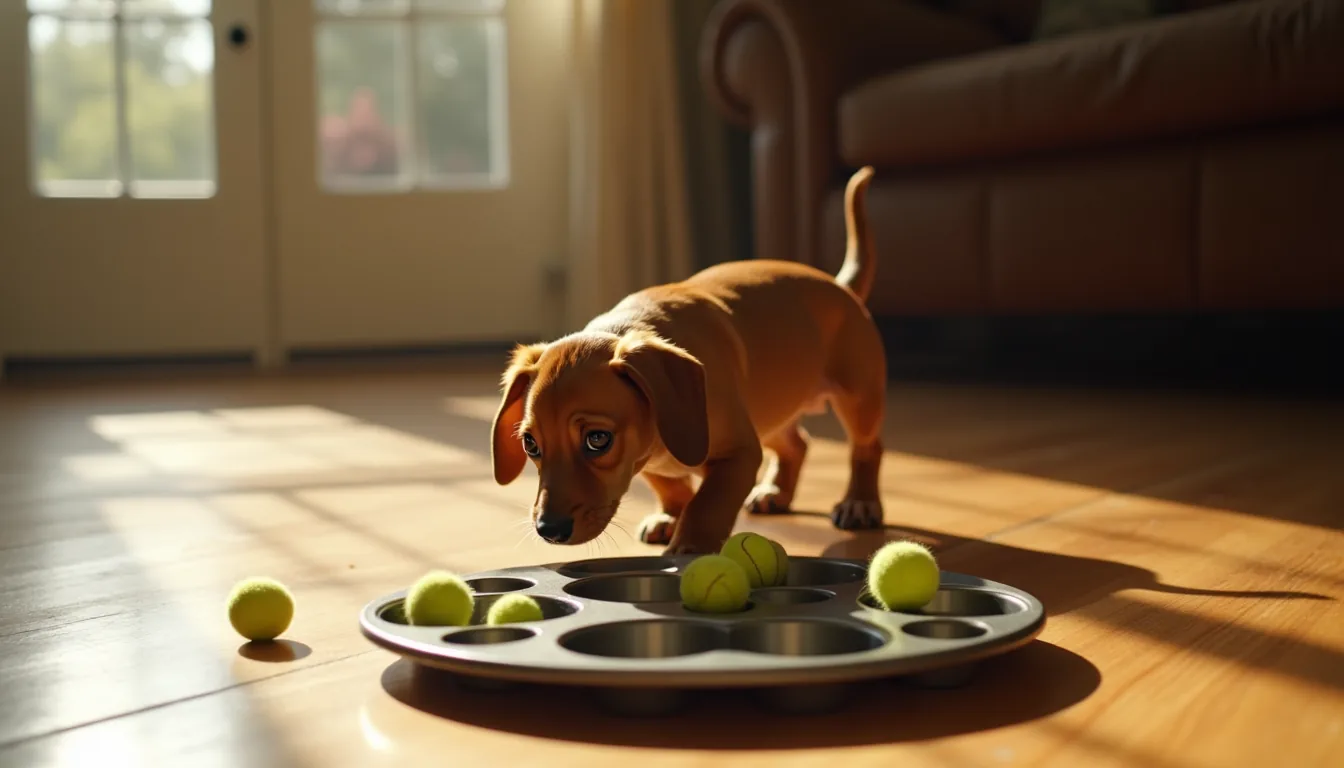
Drop a few pieces of your puppy’s kibble into a standard muffin tin, cover each cup with a tennis ball, and let your puppy figure it out. It sounds almost too simple, but for a young puppy who has never encountered this before, it’s genuinely challenging. Start with only 3–4 cups covered so your puppy gets early wins and stays motivated.
2. Sniff-and-Find Scatter Feeding
Instead of putting kibble in a bowl, toss it into a patch of grass or scatter it across a textured mat. Your puppy uses their nose to locate every piece — and a dog’s nose is connected to a significant portion of their brain. Even 5 minutes of scatter feeding is more cognitively demanding than eating from a bowl. This is one of the best free mental stimulation options for puppies because it costs nothing and uses their meal.
3. Which Hand
Hold a treat in one closed fist and offer both fists to your puppy. Wait for them to nose or paw the correct hand, then open it and reward. This teaches impulse control and cause-and-effect thinking simultaneously.
4. Name That Toy
Pick one toy and repeat its name every time your puppy interacts with it. After a week, ask your puppy to “get the rope” and see if they go for it. Puppies can learn object names faster than most owners expect.
5. Box Exploration
Put a cardboard box on the floor with a few treats hidden inside. Let your puppy investigate at their own pace. Novel objects engage the brain’s curiosity circuits and also build confidence — a skill that pays off enormously at the vet or in new environments. For more ideas like these, check out our guide to indoor enrichment ideas for dogs.
Training as Daily Mental Exercise for Puppies
A single 5-minute training session — sit, stay, touch, drop it — works a puppy’s brain harder than most owners realize. Training asks your puppy to listen, process language, suppress impulses, and execute a physical response, all at once. That’s a lot of cognitive load for a brain that’s still learning that the word “sit” is even a word.
Keep sessions to 3–5 minutes maximum for puppies under 16 weeks. Their attention spans are short, and ending on a success is more valuable than drilling a skill until they’re checked out. Two or three micro-sessions per day beats one long session every time.
Useful skills to teach in the first few months:
- Sit and down — foundation for almost every other behavior
- Touch (nose to hand) — great focus exercise, useful for redirecting
- Stay — builds impulse control directly
- Name recognition — the most important skill of all
- Drop it / leave it — practical safety skill and impulse control
Training also deepens the bond between you and your puppy in a way that passive play doesn’t. Your puppy is learning that paying attention to you produces good things — which is the foundation of every advanced skill they’ll ever learn.
A note on chewing: yes, chewing is mentally stimulating for dogs. It releases calming hormones and occupies the jaw and brain simultaneously. A bully stick or a frozen chew after a training session is a legitimate enrichment activity, not just a treat. The ASPCA recommends providing appropriate chew outlets to reduce destructive chewing — so a good chew toy isn’t indulgence, it’s prevention.
Nose Work: The Easiest High-Value Enrichment
Hide a single treat under one of three upside-down plastic cups. Shuffle them slowly and let your puppy sniff out the right one. That’s nose work — and it’s one of the most powerful mental stimulation tools available for puppies at any age or energy level.
A dog’s sense of smell is their primary way of understanding the world. When you give your puppy a nose work task, you’re speaking their language. Even 15 minutes of mental stimulation through nose work can leave a high-energy puppy ready to nap. That’s not an exaggeration — scent work is cognitively exhausting in the best possible way.
How to build a simple nose work progression:
- Week 1: Scatter kibble in the grass and let your puppy find it with their nose
- Week 2: Hide treats in 3–4 obvious spots around one room
- Week 3: Hide treats in harder spots — under a folded towel, behind a chair leg
- Week 4: Introduce a scent (lavender or anise on a cotton ball) and hide it for your puppy to find
You can also use a snuffle mat — a rubber mat with fabric strips woven through it — to create an easy foraging challenge. Sprinkle kibble into the strips and let your puppy work through it. If you want to make your own version, our roundup of DIY mental stimulation ideas has a simple snuffle mat tutorial that takes about 20 minutes to build.
Building a Realistic Daily Enrichment Routine
Most puppies do best with three short enrichment windows per day rather than one long session. A workable structure looks like this: a 5-minute training session in the morning before breakfast, a scatter-feed or snuffle mat at lunch, and a nose work or puzzle game in the late afternoon before the evening wind-down.
That totals roughly 15–20 minutes of active mental work — which is enough for most puppies under six months. As your puppy matures and their attention span grows, you can extend sessions and introduce harder challenges like multi-step puzzle feeders or hide-and-seek games across multiple rooms.
The single most common mistake owners make is trying to do too much at once. A puppy who is pushed past their cognitive limit will start making mistakes, losing interest, or getting mouthy. Those are signs to stop — not signs to push harder. End every session before your puppy checks out, and they’ll come back to the next one eager.
A few things that count as enrichment that owners often overlook:
- Letting your puppy sniff freely on a loose leash during walks (don’t rush them)
- Car rides to new environments — yes, car rides can be mentally stimulating for dogs because of the volume of new smells and sights they process
- Supervised exploration of new rooms or outdoor spaces
- Watching birds or squirrels through a window with you nearby
For a deeper look at structuring enrichment by energy level, our guide on enrichment for high-energy dogs covers how to scale difficulty as your puppy grows.
Our Picks: Tools Worth Having for Puppy Enrichment
These three product categories make the activities above easier to run consistently. No brand names — just the type of product and why it earns its place.
- Adjustable-difficulty sliding puzzle feeder — Lets you start with large, easy compartments and increase complexity as your puppy figures out each level; much more reusable than single-difficulty puzzles.
- Rubber-base snuffle mat with varied pile heights — The different pile heights create uneven foraging difficulty, which keeps nose work interesting longer than a flat mat with uniform strips.
- Freezer-safe silicone lick mat with suction cup — Frozen fillings extend the session from 2 minutes to 10–15 minutes; the suction cup keeps it in place on tile or a crate floor. Pair it with our lick mat recipes for puppies for filling ideas that are safe for young dogs.
FAQ: Mental Stimulation for Puppies
How much mental stimulation does a puppy need per day?
Most puppies under six months do well with three sessions of 5–10 minutes each, totaling 15–30 minutes of active mental work daily. The right amount varies by breed and individual temperament — a working breed puppy will generally need more than a toy breed. Watch your puppy’s behavior: a well-stimulated puppy settles easily after activity; an under-stimulated one keeps pestering you for engagement.
What are the best mental stimulation activities for puppies at home?
Scatter feeding, muffin tin puzzles, short training sessions, and snuffle mats are the most accessible because they require no special equipment. Nose work games — hiding treats around a room for your puppy to find — are particularly effective because they engage your puppy’s strongest sense. Rotate activities so your puppy doesn’t habituate to any single challenge.
Is chewing mental stimulation for dogs?
Yes — chewing engages the brain and releases calming neurochemicals, which is why puppies who have appropriate chew outlets are often calmer overall. It’s not the same as problem-solving enrichment, but it counts as a legitimate mental activity. Offer species-appropriate chews like bully sticks, raw bones, or rubber chew toys rather than rawhide, which carries a choking risk.
Can I do mental stimulation with my puppy without using food?
Yes, though food makes early training and puzzle work easier because it’s a universally motivating reward. Mental stimulation for dogs without food can include tug games, fetch with rules (sit before the throw), scent work using a favorite toy instead of treats, and training with praise and play as the reward. Some puppies are more toy-motivated than food-motivated — experiment to find what drives yours.
Are car rides mental stimulation for dogs?
They can be, especially for puppies who are still being socialized. A car ride to a new parking lot, a park, or even just a drive-through exposes your puppy to a flood of new smells, sounds, and sights that require active processing. It’s passive enrichment rather than active problem-solving, so it doesn’t replace training or nose work — but it’s a valid addition to a varied enrichment routine.
Start With One Activity Today
Pick one activity from this list — the muffin tin puzzle, a 5-minute training session, or a handful of kibble scattered in the grass — and do it before your puppy’s next meal. That’s it. Mental stimulation for puppies compounds: the more consistently you build these habits in the first few months, the easier your puppy becomes to live with. One small session today is worth more than a perfect routine you start next week. For a broader set of ideas to keep in rotation, our full list of best dog enrichment activities has options for every age and energy level.