7 Genius Dog Enrichment Ideas for Rainy Days
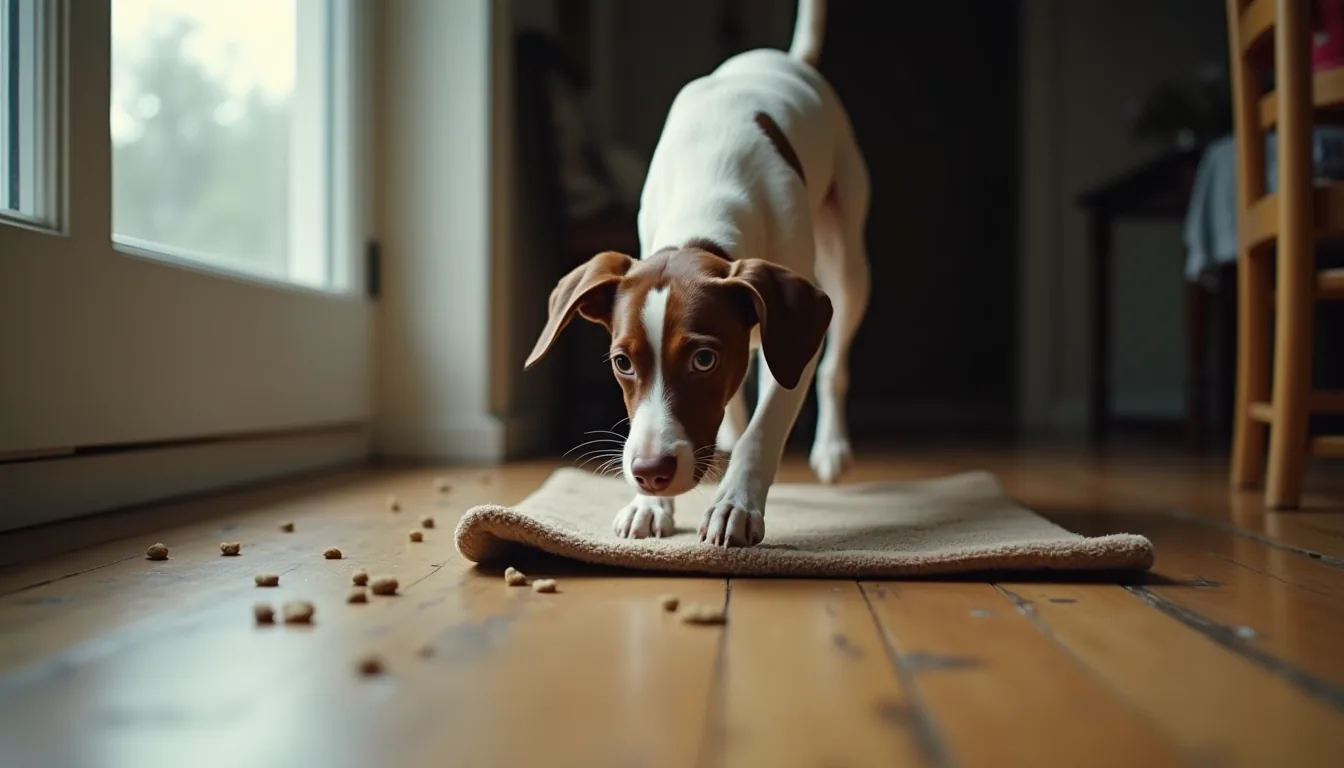
The best dog enrichment ideas for rainy days don’t require a yard, a car, or even much space — and on a gray Saturday when your pointer has already lapped the hallway six times, that matters. Rain cancels the walk, but it doesn’t have to cancel your dog’s mental workout. Everything in this post works in a standard living room, and most of it costs nothing or uses things you already own.
1. Scatter Feeding: The Easiest Rainy-Day Reset
Take your dog’s kibble — the full meal, not a treat — and scatter it across a sniff mat or even directly onto a clean patch of carpet. A dog working to find 40 pieces of kibble one by one uses far more energy than a dog eating from a bowl in 90 seconds. The nose is doing the heavy lifting, and nose work is genuinely tiring in a way that pacing the hallway is not.
Scatter feeding works because it taps into a dog’s seeking behavior — the same drive that makes a terrier dig or a hound follow a trail. You’re not just feeding your dog; you’re giving the brain a job. According to the AKC, mental stimulation can be just as exhausting as physical exercise for many breeds, which explains why a 15-minute sniff session can settle a dog better than a 20-minute jog.
Start with the dog out of the room, scatter the food, then release them. The anticipation adds another layer of engagement. If you want to step it up, use a muffin tin with tennis balls covering each cup — your dog has to remove the ball before getting the kibble underneath.
For more ideas that work on this same principle, check out our guide to mental stimulation at home — several of those activities translate directly to rainy days.
2. Nose Work Boxes: Rainy Day Dog Enrichment Ideas That Scale
Set out five cardboard boxes in a row. Hide a high-value treat — a small piece of cheese, a bit of chicken — in just one of them. Let your dog sniff the line and find it. That’s the foundation of nose work, and it’s one of the most effective dog enrichment ideas for rainy days because the difficulty scales infinitely as your dog gets better.
Beginner Setup
Use open boxes, hide the treat visibly at first, and reward big when your dog puts their nose in the right one. The goal at this stage is just building the association between sniffing and reward.
Intermediate Setup
Close the boxes. Add more containers — paper bags, plastic bins, old shoeboxes. Rotate which one holds the treat so your dog can’t rely on memory. Keep sessions to 5–10 minutes; nose work fatigues dogs faster than you’d expect, and stopping while they’re still engaged keeps them wanting more.
Advanced Setup
Introduce a specific scent — birch oil is standard in formal nose work — and pair it with the reward. Over time your dog learns to alert on that scent alone. This is the same skill used in competition nose work and search-and-rescue training. You don’t need a class to start; you just need consistency.
3. Staircase Recall Sprints
If your home has stairs, you have a cardio machine that also requires focus. Stand at the top, call your dog up, reward with a treat or toy. Walk down, call them up again. Ten repetitions and most medium-to-large dogs are noticeably calmer. The combination of physical effort (stairs are harder than flat ground) and the mental engagement of responding to a cue makes this more effective than just letting a dog run laps.
One practical note: this isn’t appropriate for puppies under 12 months or dogs with joint issues. For those dogs, skip ahead to the lick mat or puzzle feeder sections instead. The ASPCA recommends consulting your vet before starting any new exercise routine with a dog recovering from injury or with known orthopedic conditions.
You can layer in training by adding a “wait” at the bottom before you release them to come up. Now it’s not just exercise — it’s impulse control practice. Pair the recall sprint with a sit-stay at the top and you’ve turned a rainy afternoon into a full training session without leaving the house.
If you have a high-drive dog who seems to need even more than this, our post on enrichment for high-energy dogs has a longer list of intensity options worth bookmarking.
4. Lick Mats and Frozen Feeders
A silicone lick mat smeared with plain pumpkin puree and stuck in the freezer for two hours becomes a 20-to-30-minute occupation. The repetitive licking motion has a documented calming effect — it’s the same reason anxious dogs often chew — and a frozen mat extends the session significantly compared to a room-temperature one.
Fillings that work well and are safe for most dogs:
- Plain canned pumpkin (not pie filling)
- Unsweetened plain yogurt
- Mashed banana
- Xylitol-free peanut butter (check the label — xylitol is toxic to dogs)
- Softened sweet potato
Avoid anything with onion, garlic, grapes, or artificial sweeteners. If you want a full set of tested combinations, our lick mat recipe guide covers fillings by dietary need and freeze time.
The lick mat works especially well as a wind-down after a more active session like the staircase sprints. It signals to your dog that the high-energy portion is over and it’s time to settle.
5. Indoor Puzzle Feeders and DIY Brain Games
A $15 sliding puzzle feeder — the kind where your dog has to push compartment covers aside to reach kibble — can occupy a food-motivated dog for 10 to 25 minutes depending on difficulty level. Start on the easiest setting and only increase difficulty when your dog solves it in under two minutes consistently.
If you don’t want to buy anything, the muffin tin game mentioned earlier is a solid starting point. Another zero-cost option: the “which hand” game. Hold a treat in one closed fist, present both fists, and wait for your dog to nose or paw the correct hand. It sounds simple, but it requires your dog to make a deliberate choice and wait for confirmation — that’s real cognitive work.
Rotate puzzles every few sessions rather than using the same one daily. Dogs solve familiar puzzles on autopilot after a few repetitions, which means the mental effort drops significantly. Novelty is what keeps the brain engaged. For more structured at-home options, our post on dog puzzle ideas at home has setups that range from beginner to genuinely challenging.
You can also build your own puzzles from cardboard tubes, egg cartons, and muffin tins — our DIY enrichment toy guide walks through exactly how to assemble them with no tools required.
6. Training Micro-Sessions: 5 Minutes, 5 Reps
Five minutes of training burns more mental energy than most people expect, especially when you’re working on something new. Pick one behavior your dog doesn’t have on solid cue yet — “place,” “spin,” “back up,” “leave it” — and do five clean repetitions. Stop. Come back an hour later and do five more.
Short sessions work better than long ones for most dogs because focus degrades after about five minutes of active training. You get better learning and less frustration on both ends. A rainy day gives you natural checkpoints: do a session, let your dog rest while you make coffee, do another session.
If your dog already knows all the basics, work on duration and distraction instead. A solid 30-second “stay” while you walk to another room is harder than it looks and genuinely satisfying to build. Use a marker word or clicker to pinpoint the exact moment your dog is doing the right thing — precision matters more than repetition volume.
7. Sensory Enrichment: New Smells and Textures
Bring the outside in. A handful of leaves from the porch, a pinecone, a stick — set them on the floor and let your dog investigate. Novel smells from outside carry information about other animals, weather changes, and plants your dog has never encountered, and processing that information is cognitively stimulating in a way that a familiar toy simply isn’t.
You can also rotate textures underfoot. A yoga mat, a rubber doormat, a folded blanket, a plastic storage lid — arrange them in a path and walk your dog across them slowly. This is used in puppy socialization but works for adult dogs too, especially those who are sensitive or reactive, because it builds confidence through controlled novelty.
Herb bundles are another option. Tie together fresh rosemary, mint, or lavender and let your dog sniff — not eat — the bundle. Different herbs produce different reactions; some dogs are intensely interested, others are indifferent. Either response is fine. The point is novel sensory input, not a specific reaction.
Our Picks
These three product categories make rainy-day enrichment sessions faster to set up and easier to repeat:
- Snuffle mat with adjustable pile depth — a deeper pile forces more sustained sniffing effort than a flat scatter surface, which means a longer session from the same amount of kibble.
- Silicone lick mat with suction-cup base — the suction base sticks to tile or a low cabinet door, which keeps the mat in place and encourages your dog to stand and work rather than carry it off to a corner.
- Multi-level sliding puzzle feeder — adjustable difficulty means one product grows with your dog’s skill level instead of becoming obsolete after a week.
FAQ
How do I tire out my dog on a rainy day without going outside?
Combine mental and physical work: a 10-minute nose work session followed by staircase recall sprints, then a frozen lick mat to wind down. That sequence addresses both energy types and typically results in a dog that settles voluntarily within 30–40 minutes. You don’t need outdoor space — you need variety.
How long should indoor enrichment sessions be for dogs?
Most dogs do best with 10–20 minute sessions with rest breaks in between, rather than one long continuous session. Mental fatigue sets in faster than physical fatigue for many dogs, especially during nose work or active training. Watch for signs of disengagement — sniffing the floor randomly, wandering away — and stop before that point.
Is it okay to do enrichment activities every day?
Yes, and for most dogs it’s beneficial. Daily mental stimulation reduces anxiety-related behaviors like destructive chewing and excessive barking. The key is varying the activity so your dog doesn’t habituate to a single routine. Rotate through different types — nose work one day, training the next, puzzle feeder the day after.
What enrichment activities are safe for puppies on rainy days?
Avoid anything that puts sustained stress on developing joints — so no staircase sprints for puppies under 12 months. Scatter feeding, lick mats, gentle nose work with open containers, and short training sessions (2–3 minutes max) are all appropriate. Keep sessions short and stop before the puppy gets overtired or frustrated.
My dog ignores puzzle feeders. What am I doing wrong?
The puzzle is probably too hard too fast. Start with the food visible and the puzzle open or barely covered, and reward generously the first several times. You’re teaching the concept — “interacting with this object produces food” — before you add difficulty. Most dogs who “don’t like” puzzles just haven’t had enough easy wins to understand the game yet.
Start With One Activity Today
Pick the scatter feeding setup — it takes 30 seconds and uses food you already have. Do it at your dog’s next meal instead of putting the bowl down. That single swap introduces your dog to sniff-based feeding and gives you a baseline for how long it holds their attention. Once you see how a dog responds to that first session, the rest of these dog enrichment ideas for rainy days will make a lot more sense to sequence and build on.