Mental stimulation for dogs isn’t a luxury — it’s what stands between you and a shredded throw pillow at 2 p.m. on a Tuesday. Your Australian shepherd has already lapped the backyard three times, and now she’s staring at you with that hollow, restless look that every dog owner recognizes. Physical exercise is only half the equation. The brain needs work too, and the right kind of challenge can tire out a dog faster than a long run.
Why Mental Stimulation for Dogs Matters More Than Extra Walks
A 45-minute sniff walk can leave a beagle more satisfied than a 90-minute jog — because the nose is doing cognitive work the whole time. Scent processing engages a significant portion of a dog’s brain, and that sustained focus burns mental energy in a way that trotting beside you on a leash simply doesn’t. This is why a dog can come home from a long hike and still pace the hallway, but spend 20 minutes on a puzzle feeder and crash on the couch.
The underlying issue is unspent mental energy. Dogs were bred for specific jobs — herding, tracking, retrieving, guarding — and most household pets never get to do those jobs. That energy doesn’t disappear. It redirects into barking, chewing, digging, or the kind of attention-seeking behavior that makes you want to close your laptop and give up.
Before you add another walk to the schedule, ask whether your dog is physically tired or mentally satisfied. Those are different states, and they require different solutions. A dog who is mentally engaged is also a calmer, more confident dog — less reactive on leash, less destructive at home, and easier to train because their brain is already primed to problem-solve.
According to the AKC, dogs who receive consistent mental enrichment show fewer stress-related behaviors over time. That tracks with what most experienced dog owners already observe: a bored dog is a creative dog, and not in a good way.
Nose Work: The Easiest Mental Workout You’re Not Using
Start with three plastic cups and a single piece of kibble. Turn one cup upside down over the kibble, shuffle them slowly, and let your dog find it. That’s the foundation of nose work — and it’s one of the most effective mental stimulation activities available, regardless of breed or age.
Nose work scales from that simple shell game all the way to competitive scent detection trials. At home, you don’t need equipment or a certification. You need a few containers, some high-value treats, and about 10 minutes.
Muffin Tin Puzzle
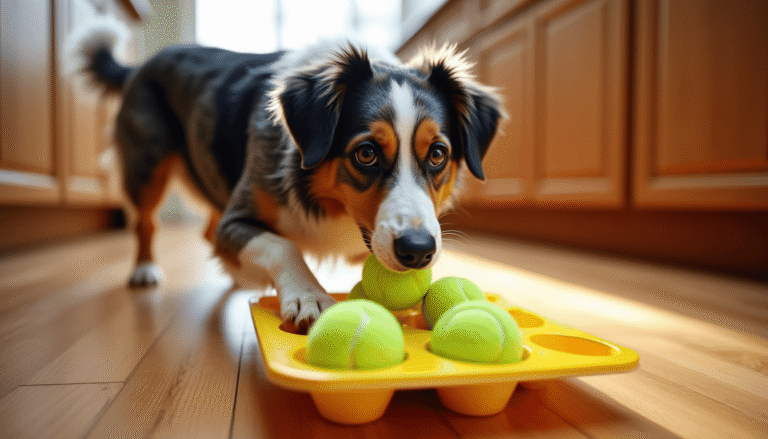
Place treats in some of the cups of a standard muffin tin, then cover all the cups with tennis balls. Your dog has to remove each ball to check underneath. It sounds simple — it is — but watching a dog work through it methodically is genuinely impressive. Use your dog’s actual meal kibble instead of extra treats so you’re not adding calories.
Scatter Feeding in Grass
Instead of a bowl, toss your dog’s entire meal into a patch of grass and let them sniff it out piece by piece. This takes a 90-second meal and stretches it to 10-15 minutes of focused nose work. It’s particularly effective for anxious dogs because the sniffing itself activates the parasympathetic nervous system — the “rest and digest” state.
Box Search
Line up five or six cardboard boxes in a row, hide a treat in one, and send your dog to find it. Rotate which box gets the treat each round. Once your dog is reliably searching all boxes, start hiding the treat inside a crumpled paper ball inside the box to add another layer of difficulty.
Puzzle Feeders: Turning Every Meal Into a Problem to Solve
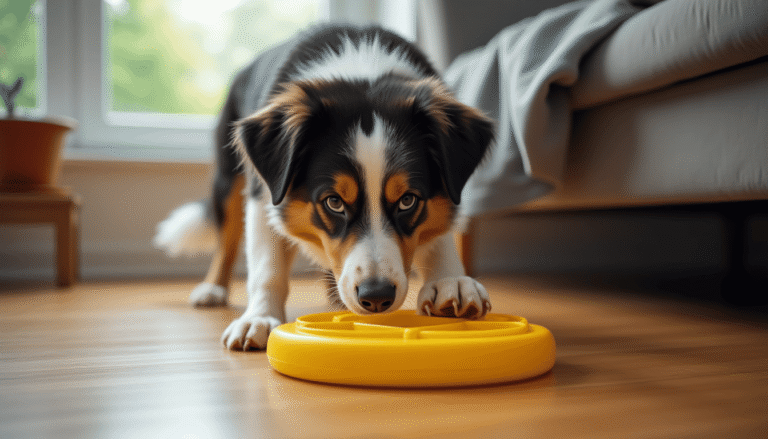
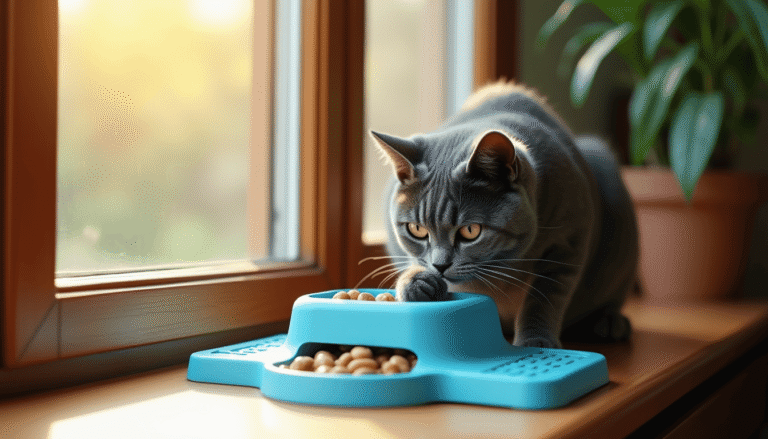
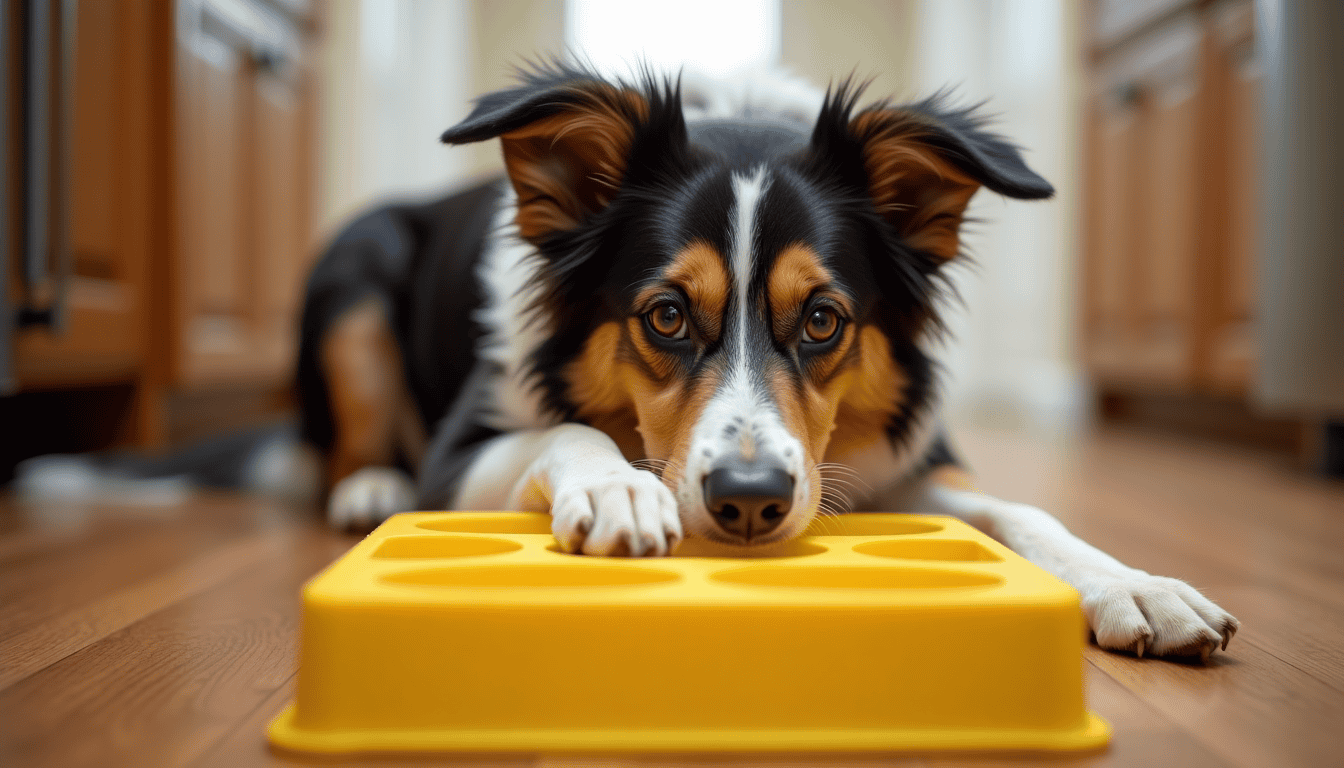
A Level 1 puzzle feeder — the kind with sliding compartments — takes most dogs about 90 seconds to figure out the first time and about 20 seconds by the third session. That’s not a failure; that’s your signal to move up a level. Puzzle feeders are rated by difficulty, and matching the right level to your dog matters more than the specific design.
For dogs new to puzzle feeders, start with a simple snuffle mat or a flat lick mat. The goal in the first week isn’t challenge — it’s teaching your dog that interacting with an object produces food. Once that association is solid, introduce compartments, levers, and sliders.
A few practical notes:
- Supervise the first few sessions with any new puzzle. Some dogs flip feeders over and eat from the floor, bypassing the puzzle entirely.
- Wash puzzle feeders after every use. Wet kibble residue in plastic crevices goes rancid quickly.
- If your dog gets frustrated and disengages within 60 seconds, the puzzle is too hard. Drop back a level and rebuild confidence.
Rotate between two or three different feeders throughout the week so novelty stays in the mix. A puzzle your dog has memorized provides almost no cognitive challenge.
Training Sessions as Mental Stimulation: 10 Minutes Is Enough
Teaching a dog to identify and retrieve a specific toy by name — “go get Rope” versus “go get Ball” — is one of the more demanding cognitive tasks you can give a dog at home. Border collies and poodles tend to pick this up in a few sessions; other breeds may take weeks. Either way, the process of learning is the point, not the speed.
Short training sessions (5-10 minutes, twice a day) are more effective than one long session because dogs consolidate learning during rest. End every session before your dog loses interest — ideally on a success, even if you have to make the last ask an easy one.
You don’t need to work on new behaviors every session. Proofing existing behaviors in new environments is cognitively demanding on its own. Asking your dog to hold a “stay” while you walk into another room, or to perform a “down” in the middle of a busy parking lot, requires real mental effort.
Some behaviors worth teaching specifically for enrichment value:
- Object discrimination — learning the names of multiple toys or household items.
- Back-chaining a sequence of behaviors (sit → down → roll over, on a single cue).
- Targeting — touching a specific spot with their nose or paw on command.
- Impulse control games like “it’s yer choice” where the dog learns to wait before taking food from an open hand.
Environmental Enrichment: Changing What Your Dog Sees and Smells at Home
A new cardboard box left in the middle of the living room floor will hold most dogs’ attention for a solid 10 minutes. They’ll sniff it, circle it, paw at it, and investigate every seam. That’s environmental enrichment — and it costs nothing.
The principle is novelty. Dogs habituate to their environment quickly, which means the same furniture, the same smells, the same layout every day becomes invisible to them. Introducing something new — even something small — reactivates their curiosity and gets them using their brain.
Practical ideas that don’t require buying anything:
- Rearrange furniture in one room.
- Place a worn piece of your clothing (unwashed) in a new spot for your dog to investigate.
- Open a window your dog doesn’t usually have access to.
- Bring in a stick, a pinecone, or a handful of leaves from outside for your dog to sniff.
For dogs who spend significant time alone, a window perch or baby gate that allows access to a new room can meaningfully reduce boredom. The ASPCA notes that environmental enrichment is a key component of reducing separation-related stress behaviors in dogs left home alone.
Rotate enrichment items in and out of your dog’s environment on a weekly basis rather than leaving everything available all the time. Scarcity maintains novelty.
Our Picks
These three product categories consistently deliver the best return on investment for mental enrichment at home:
- Multi-level sliding puzzle feeder with compartments — The layered design forces dogs to solve two steps before accessing the reward, which sustains focus longer than single-action feeders.
- Snuffle mat with variable-depth fabric strips — Uneven strip heights create unpredictable hiding spots, so your dog can’t develop a pattern and has to nose-search every session from scratch.
- Rubber fillable chew toy designed for freezing — Freezing the filling extends the challenge duration from 5 minutes to 20+, making it the most time-efficient single enrichment item for a busy day.
FAQ
How much mental stimulation does a dog need per day?
Most adult dogs benefit from 20-30 minutes of dedicated mental enrichment daily, separate from physical exercise. High-drive working breeds — border collies, Belgian Malinois, Australian shepherds — often need more. Puppies and senior dogs do better with shorter, more frequent sessions of 5-10 minutes to avoid fatigue.
Can mental stimulation replace physical exercise for dogs?
No — they serve different physiological functions. Mental enrichment burns cognitive energy and reduces stress-related behaviors, but it doesn’t provide the cardiovascular and musculoskeletal benefits of physical activity. Use both. On low-activity days (rainy weather, recovery from injury), mental stimulation can offset some of the behavioral fallout from skipped walks.
What are the signs that my dog isn’t getting enough mental stimulation?
Destructive chewing, excessive barking, persistent attention-seeking, and restlessness after physical exercise are the most common indicators. Some dogs also develop repetitive behaviors — spinning, pacing, obsessive licking — when chronically under-stimulated. If these behaviors appear suddenly, rule out medical causes with your vet before attributing them to boredom.
Are puzzle feeders safe to leave with a dog unsupervised?
Most puzzle feeders are not designed for unsupervised use. Hard plastic components can splinter if a determined dog decides to chew rather than solve, and small parts can become choking hazards. Supervise until you know exactly how your dog interacts with a specific feeder, then make a judgment call based on their chewing style.
What’s the best mental stimulation activity for a senior dog with limited mobility?
Nose work is ideal — it requires no jumping, running, or physical strain, and it scales to any mobility level. Scatter feeding on a flat surface, lick mats, and short training sessions of familiar behaviors are also well-suited. Avoid puzzle feeders that require pawing or pushing if your dog has joint pain in their legs or shoulders.
Start Here
Pick one activity from this post and try it at your dog’s next mealtime instead of a bowl. Scatter feeding in grass or a muffin tin puzzle both work with food your dog is already eating, so there’s no prep and no extra cost. Mental stimulation for dogs doesn’t require a full routine overhaul — it requires one small swap, repeated consistently, until it becomes the default. Build from there.