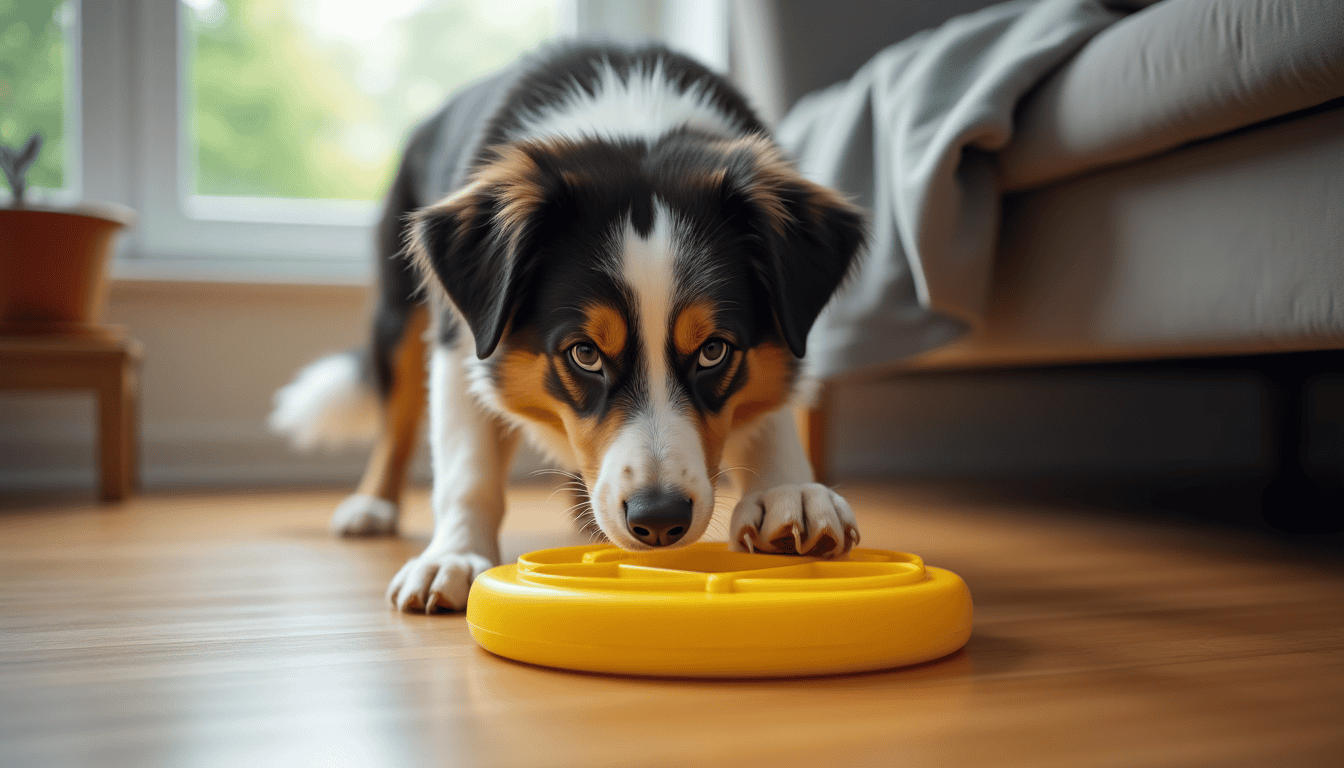
The best dog enrichment activities aren’t the ones with the fanciest gear — they’re the ones your dog will actually engage with for more than 90 seconds. Picture this: your Australian shepherd has been staring at you for 20 minutes straight, the leash is sitting untouched by the door because it’s pouring outside, and you’re out of ideas. That’s exactly the moment this list was built for.
1. Sniff Work: The Fastest Way to Tire Out Any Dog
A 15-minute nose work session can exhaust a high-drive dog more thoroughly than a 45-minute walk. That’s not an exaggeration — it’s something most owners notice the first time they try it. The reason is straightforward: scent processing is cognitively demanding, and dogs are built to do it constantly. When you give them a structured outlet for it, they settle faster and stay calmer longer.
The simplest version requires nothing but your kitchen. Hide a few pieces of your dog’s kibble in a muffin tin, cover each cup with a tennis ball, and set it on the floor. Your dog has to sniff out which cups hold food and flip the balls. That’s it. Once they’ve mastered the muffin tin, graduate to hiding food in cardboard boxes stacked around a room, then to hiding a specific scented object (a cotton swab rubbed with birch oil is the standard in formal nose work classes).
Start with your dog’s regular meal portion rather than extra treats — this keeps calories in check and makes the activity a daily habit instead of an occasional bonus. Most dogs catch on within two or three sessions, and the focus they develop transfers to other training contexts too.
If you want to take it further, the AKC offers a formal scent work titling program with beginner levels that are genuinely accessible for pet dogs — not just competition dogs.
2. Puzzle Feeders and Slow Bowls: Turn Every Meal Into a Job
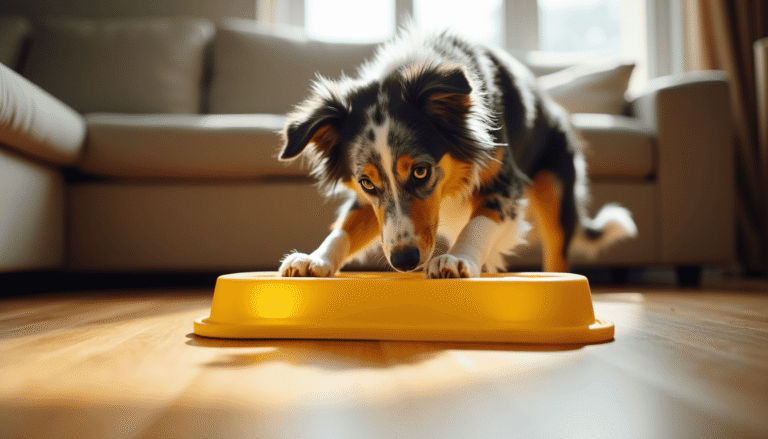
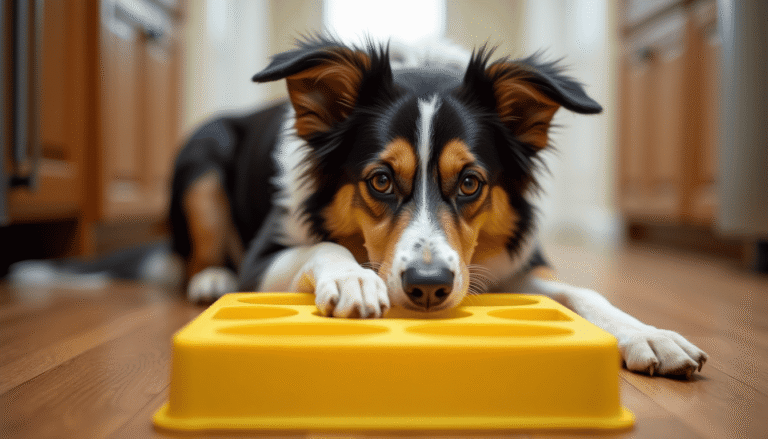
A standard food bowl delivers 2 cups of kibble in about 45 seconds. A Level 2 puzzle feeder stretches that same meal to 8–12 minutes and makes your dog work for every piece. That shift alone changes the texture of your dog’s day.
Puzzle feeders come in difficulty levels, usually marked 1 through 4. Level 1 involves simple sliding compartments. Level 4 requires your dog to lift, spin, and slide multiple components in sequence. Start one level below what you think your dog can handle — frustration that leads to giving up is worse than a challenge that feels slightly too easy at first.
Matching Puzzle Difficulty to Your Dog
Not every dog needs a Level 3 puzzle. A senior dog with arthritis may struggle with mechanisms that require pawing, so a flat snuffle mat or lick mat works better. A young working-breed dog may solve a Level 2 in under two minutes and need something harder within a week.
Rotating Feeders to Prevent Boredom
Dogs figure out puzzles quickly. Once your dog solves a feeder in under three minutes consistently, it’s no longer enriching — it’s just a slower bowl. Keep two or three feeders in rotation and reintroduce them after a few weeks of rest. The reintroduction often takes them a moment longer than you’d expect.
Wet Food vs. Dry Kibble in Feeders
Dry kibble works best in sliding and compartment-style puzzles. Wet food, raw food, or peanut butter belongs in lick mats and Kong-style toys. Mixing the two in the wrong feeder type creates a cleanup problem and can make the activity aversive for your dog if the food gets stuck in hard-to-reach places.
3. DIY Enrichment Activities That Cost Almost Nothing
A cardboard box filled with crumpled newspaper and a handful of kibble hidden inside costs nothing and keeps most dogs busy for 10 minutes. Before you spend money on enrichment gear, work through this list of zero-cost options — they’re legitimate activities, not just filler.
- Box dig: Fill a cardboard box with crumpled paper, fabric scraps, or empty toilet paper rolls. Hide treats throughout. Let your dog shred and dig to find them.
- Towel roll: Lay a bath towel flat, scatter kibble across it, then roll it up loosely. Your dog unrolls it to reach the food.
- Ice block: Freeze kibble or small treats in a block of water. Place it on a mat outside and let your dog lick and paw it apart on a warm day.
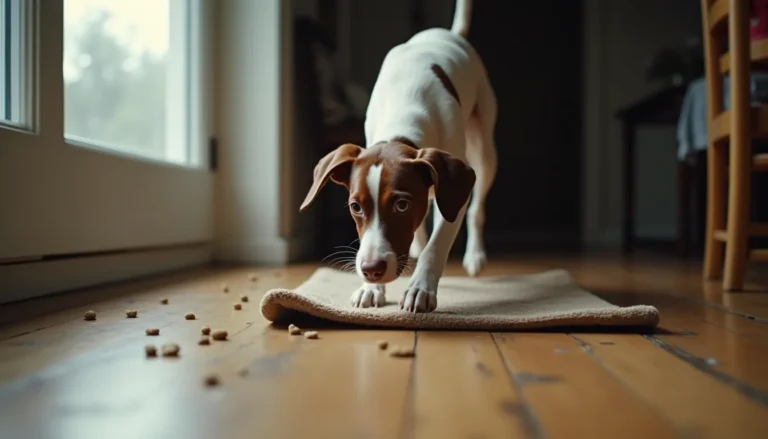
- Scatter feeding: Toss your dog’s entire meal into the grass and let them forage. This is especially effective for dogs who eat too fast or seem disinterested in their food.
- Staircase toss: If you have stairs, toss a ball to the bottom landing and let your dog retrieve it back up. The incline adds physical effort without requiring outdoor space.
The common thread across all of these is that they ask your dog to make decisions and use their senses — which is what enrichment actually means, stripped of the marketing language.
4. Training as Enrichment: 10 Minutes That Change the Day
A 10-minute training session burns more mental energy than most owners realize. Teaching a new behavior from scratch — not reviewing a known one — is the key. Your dog has to think, experiment, fail, and adjust. That cognitive loop is tiring in the best way.
If your dog already knows sit, down, and stay, move to behaviors that require body awareness: back up, spin, place (go to a specific mat and lie down), or nose touch (touch your hand with their nose on cue). These aren’t just tricks — they build the kind of focus that makes your dog easier to live with in general.
Keep sessions to 5–10 minutes maximum and end before your dog loses interest, not after. Ending on a successful repetition of something your dog knows well creates a positive association with training that compounds over time.
Dogs experiencing anxiety or reactivity often benefit significantly from structured training as enrichment. The Fear Free Happy Homes resource library has solid guidance on low-stress training approaches for sensitive dogs.
One practical structure: spend the first 3 minutes on a known behavior for confidence, the middle 5 minutes on the new skill, and the last 2 minutes on free play or a chew. That arc keeps the session productive without ending on frustration.
5. The Best Dog Enrichment Activities for Rainy or Low-Energy Days
Some days, you have 10 minutes and low bandwidth. These are the best dog enrichment activities for exactly that scenario — high return, minimal setup, and no outdoor access required.
- Kong stuffing: Fill a rubber Kong with a layer of peanut butter, a layer of kibble, and a plug of cream cheese. Freeze it the night before. Lasts 20–30 minutes for most dogs.
- Chew rotation: Rotate between bully sticks, yak chews, and raw marrow bones (frozen) on different days. Chewing releases serotonin and genuinely calms most dogs — it’s not just a distraction.
- Scent introduction: Place a drop of dog-safe essential oil (lavender, chamomile) on a cotton ball in a sealed container with small holes. Let your dog investigate it. Novel scents alone are stimulating.
- Window perch: If your dog doesn’t already have a spot with a view, a low bench or ottoman placed at a window gives them visual access to the outside world. Many dogs will self-entertain for 30+ minutes just watching.
- Hide and seek: Ask your dog to stay, hide in another room, then call them. When they find you, reward with play or a treat. Simple, no equipment, and dogs who know a solid stay can do this indefinitely.
On days when you’re genuinely depleted, a frozen Kong and a good chew is not a failure — it’s a legitimate enrichment plan.
Our Picks
These three product categories consistently earn their place in a rotation of enrichment tools. No single product will work for every dog, but these categories cover the widest range of dogs and activity types.
- Adjustable-difficulty sliding puzzle feeder — Unlike fixed-level puzzles, adjustable versions grow with your dog’s skill so you’re not replacing them every few months.
- Rubber Kong-style stuffable toy (large, dishwasher-safe) — The dishwasher-safe feature matters more than it sounds; if cleaning is annoying, you won’t use it consistently.
- Textured silicone lick mat with suction base — The suction base keeps it stationary on tile or tub surfaces, which makes it usable during bath time or while you’re cooking dinner.
FAQ
How many enrichment activities does a dog need per day?
Most dogs do well with one or two enrichment activities per day, not counting walks. The goal is to address both mental and physical needs — a puzzle feeder at mealtime plus a 20-minute training session covers a lot of ground. High-drive breeds like border collies or Belgian Malinois often need more, while senior or low-energy dogs may be satisfied with one well-chosen activity.
Can enrichment activities replace daily walks?
Not entirely, but they can reduce the amount of physical exercise a dog needs to feel settled. Walks provide social exposure, novel smells, and physical movement that indoor enrichment can’t fully replicate. That said, on days when a walk isn’t possible, a strong enrichment session — nose work, a stuffed Kong, and a training session — can bridge the gap without your dog falling apart.
What enrichment activities are safe for puppies under 6 months?
Snuffle mats, lick mats, gentle scatter feeding, and short (3–5 minute) training sessions are all appropriate for young puppies. Avoid puzzle feeders with small parts that could be chewed off and swallowed. Chews should be size-appropriate and supervised — always check with your vet about safe chew options for your puppy’s specific age and breed size.
How do I know if an enrichment activity is too hard for my dog?
Watch for disengagement: if your dog sniffs the puzzle once and walks away, it’s either too hard or not rewarding enough. Try using higher-value food (real meat, cheese) instead of kibble, or drop to an easier difficulty level. Frustration that leads to giving up is a sign to scale back, not push through.
Are enrichment activities helpful for dogs with separation anxiety?
Enrichment alone won’t resolve separation anxiety, which is a clinical condition that often requires behavioral intervention and sometimes medication. However, providing a frozen stuffed toy or a long-lasting chew immediately before you leave can create a positive association with departures and give your dog something to focus on during the transition. For a full separation anxiety protocol, consult a certified applied animal behaviorist or your veterinarian.
What to Do Next
Pick one activity from this list — just one — and try it at your dog’s next meal instead of the regular bowl. Scatter feeding in the grass or a towel roll costs nothing and takes 60 seconds to set up. Once you see how differently your dog carries themselves after a meal they had to work for, adding more best dog enrichment activities to your weekly routine becomes obvious rather than obligatory. Start small, stay consistent, and build from there.